The ossuary of Ζαχαρίας (Zacharias= Zechariah)
Site item id
19739
Collection name
Item period
The Ossuary of Zacharias (Ζαχαρίας = Zechariah)
The ossuary of Zacharias stands among the most extraordinary archaeological discoveries from the late Second Temple period.
Like the Dead Sea Scrolls, it opens a rare window into the spiritual, artistic, and priestly world of Judaism on the eve of the first century CE - the generation that stood at the threshold between the Temple and the emergence of early Judeo-Christian faith.
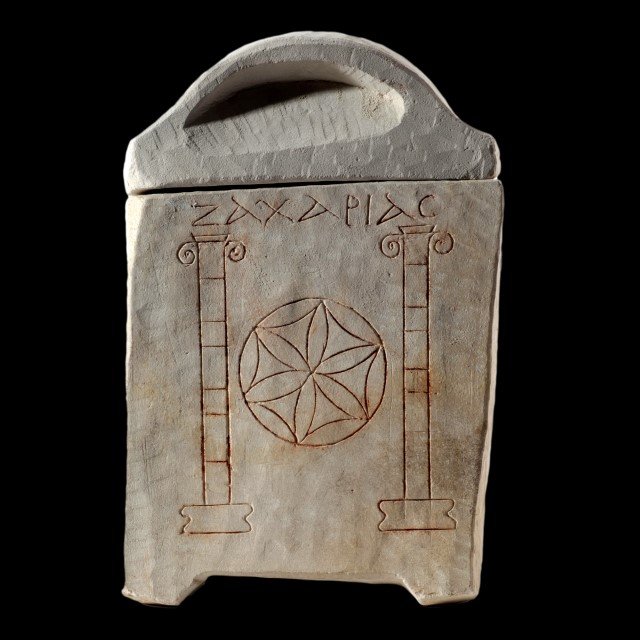
It bears the Greek inscription Ζαχαρίας (Zacharias = Zechariah), engraved with remarkable precision, and is decorated on all four sides with an exceptional set of architectural and symbolic motifs directly associated with the Jerusalem Temple.
Among the thousands of Jewish ossuaries known from this period, none presents a comparable combination of artistic quality, complexity, and symbolic intent.
The decoration follows a deliberate iconographic program rather than mere ornamentation, and its motifs - the architectural façade with free-standing columns, the hovering semi-circular form, amphora, paired crescents, and geometric meander, together evoke themes of priesthood, divine protection, and renewal.
The inscriptional form of the name Ζαχαρίας, the exclusively Greek spelling, and the priestly iconography converge to identify the deceased as a high-ranking Temple priest named Zechariah.
Given the name’s extreme rarity in the corpus, and the uniquely priestly character of the ossuary, the cumulative evidence points with exceptional strength toward identification with Zechariah the priest, father of John the Baptist, whose vision is recorded in the Gospel of Luke.
While absolute certainty can never be claimed in archaeology, the convergence of linguistic, artistic, and contextual data places this identification at a level approaching historical confidence - far beyond mere conjecture.
This interpretation rests not on a single coincidence but on the cumulative weight of linguistic, artistic, and contextual evidence, forming one of the clearest archaeological reflections of a New Testament figure ever discovered.
The ossuary was acquired several decades ago from Kamal Imam, a licensed antiquities dealer from East Jerusalem, and is today part of one of the largest and most important private collections of Jewish ossuaries in the world.
It was exhibited in two international exhibitions in the United States (2024 and 2025) with the approval of the Israel Antiquities Authority.
Unlike most ossuaries, which served merely as bone containers, the Ossuary of Zechariah was likely conceived as a commemorative monument, honoring a revered priestly figure whose status warranted unique treatment.
The rare decision to decorate all four sides confirms that it was meant to remain visible — a memorial artifact celebrating the life and faith of the man whose name it bears.
Decoration on All Four Sides
Most ossuaries from the Second Temple period were completely undecorated. The majority of decorated ones were purchased ready-made from stone workshops and typically featured two rosettes on the broad front side or simple geometric patterns. In some cases, rosettes were also carved on the narrow sides. However, decoration on the back side (the second broad face) was exceedingly rare, since ossuaries were usually placed inside burial niches or against the walls of rock-cut tombs, making the back side invisible and unnecessary to decorate.
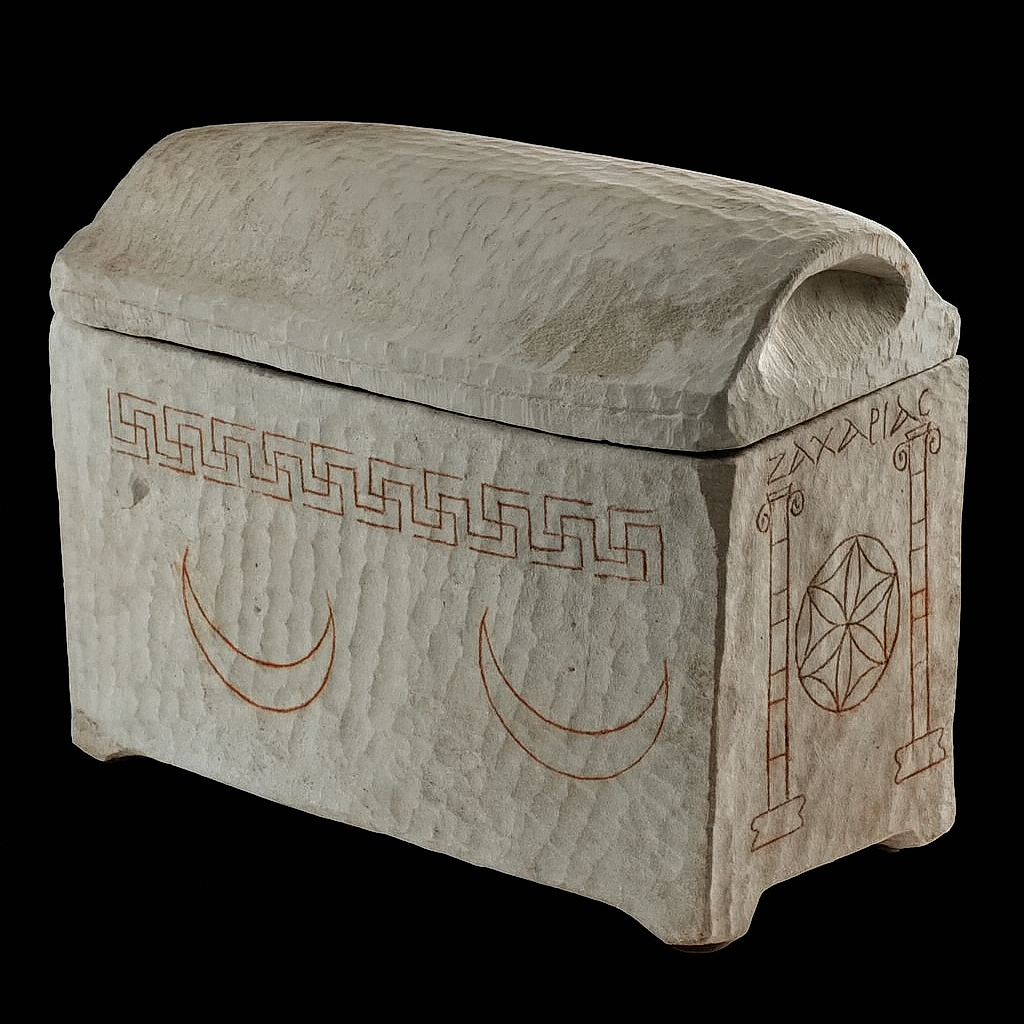
By contrast, the Ossuary of Zacharias (Ζαχαρίας) is richly and meticulously decorated on all four sides, each with a different motif. Decoration on four sides is known from only a handful of ossuaries. This exceptional artistic investment suggests that the ossuary was meant to be visible from multiple angles, indicating that it was likely placed outside a burial niche, intended for the commemoration and remembrance of a distinguished public or religious figure.
Art and Technique
The decorations were executed with exceptional precision and symmetry by a skilled artisan. Unlike most ossuaries, where designs were carved deeply into the stone or done in relief, here the motifs were engraved in shallow lines using a ruler and compass and then filled with reddish-brown pigment. This technique is very rare in Jerusalem ossuaries and creates a striking contrast with the light color of the stone. It ensured that the decorations would remain visible for centuries—indeed, they are still visible today. Producing such an ossuary required careful planning and unusually high expense.
Provenance
There is no scholarly dispute about the ossuary’s authenticity and antiquity. Its archaeological and historical significance is well established, based on the physical characteristics of its surface and the patina that developed naturally over time, as well as stylistic analogies with other ossuaries. It was acquired several decades ago from the licensed East Jerusalem antiquities dealer Kamal Imam, long regarded as one of the city’s most reliable traders. It was exhibited in two international exhibitions in the United States in 2024 and 2025 (authorized by the Israel Antiquities Authority).
Nearly 99% of all first-century ossuaries discovered in Israel were found in Jerusalem or its close vicinity (within five kilometers of the city, as well as in Jericho to the east). Thus, it is reasonable to accept the original dealer’s statement that the ossuary originated in or near East Jerusalem.
Very few ossuaries discovered in documented excavations of burial caves have yielded information about the profession or identity of the deceased beyond their names. The names were inscribed on the ossuaries themselves, not on the tomb walls. In fact, most documented first-century burial caves yielded few significant artifacts beyond the ossuaries. The finds typically included simple ceramic or glass vessels (cooking pots, flasks, and bottles), nails, dress or shroud pins, and simple earrings—none of which reveal much about the deceased.
In this respect, the Ossuary of Zacharias offers far more: it not only records the name of the deceased (in a unique spelling) but also incorporates a rich iconographic program, abundant with symbols that likely relate directly to the deceased.
The inscription and iconographic design together provide crucial evidence for identifying the individual. Thus, unlike the contested attributions of certain other ossuaries (such as the “Caiaphas” ossuary or the “Aba” ossuary sometimes linked to Mattathias Antigonus), in this case the evidence for the deceased’s identity emerges directly from the artifact itself, whose decorations “tell a story.” Therefore, the lack of a documented archaeological context does not weaken its historical interpretation.
Indeed, some of the most important archaeological discoveries from ancient Israel also lack controlled provenance—such as the Mesha Stele (now in the Louvre), the Tomb Inscription of Uzziah, King of Judah (Israel Museum), and the Temple Scroll from Qumran—all found outside formal excavations. Even the Sheshonq inscription at Megiddo and the Tel Dan Stele mentioning the “House of David” were discovered without stratigraphic context. Yet their scholarly value remains unquestioned. Likewise, the Ossuary of Zacharias derives its significance from its inscription and distinctive iconography, not from its find circumstances.
Modern scientific techniques, including patina analysis, allow reliable determination of whether inscriptions or carvings were made in antiquity or in recent times. Biogenic patina, formed by slow biological activity on the stone’s surface and within its grooves, enables confident identification of ancient versus modern engraving. Such scientific testing is crucial for both excavated and unexcavated artifacts.
The Iconographic Program
Out of roughly 3,000 known ossuaries (most of them plain or decorated only with rosettes), only a small minority bear motifs connected to architectural structures (such as “nefesh” monuments, façades, tombs, and columns), vegetation and trees, or amphorae (vessels).
A review of the entire corpus of ossuaries discovered to date shows that no other documented ossuary combines such a wide range of motifs as seen on the Ossuary of Zacharias. The integration of several rare motifs on all four sides indicates that this was not a standard commission or a ready-made purchase, but a unique creation intended to memorialize an individual of exceptional religious or communal importance.
Most of the motifs are unknown from other ossuaries. A significant number of them may hint at the deceased’s connection to sacred service—that is, suggesting that he was a priest.
It should be noted that scholars are divided regarding the meaning of ossuary decorations. Some maintain that none of the ossuary motifs—nor those on the first-century stone table from the Magdala synagogue—represent the Temple (Hachlili, Rahmani) or carry symbolic meaning. Others (Goodenough, Figuerás, Aviam 2013, and Bauckham 2015) argue that at least some of the decorations have symbolic or eschatological significance, representing hope for the afterlife and reflecting mystical concepts.
It is possible that the unusual combination of motifs on the Ossuary of Zacharias reflects ideas circulating among certain Jewish circles in the first century whose beliefs extended beyond the mainstream, such as those of the early Judeo-Christian community.
A Floating Form within a Rectangular Frame
The Rectangular Frame
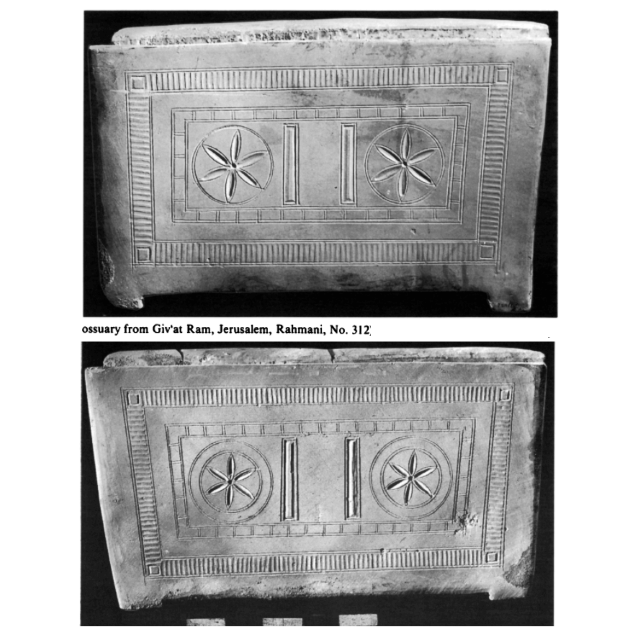
On several ossuaries discovered in Jerusalem appears a rectangular grooved frame, closed on all four sides, and in some cases two columns are depicted within it. These decorations have been interpreted by some scholars as schematic representations of the façade or side of a monumental structure, whereas Y. L. Rahmani proposed identifying them as façades of hewn burial caves.
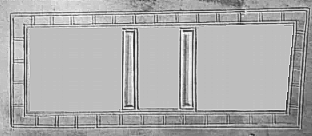
However, on the ossuary of Zacharias appears a unique variation of this motif: on the broad side of the ossuary is a grooved rectangular frame, but here openings were added in several directions. At the center of the frame appears an impressive floating form, absent from all other known ossuaries.
These exceptional features indicate that this is not a schematic rendering of a closed burial cave, but rather a schematic representation of a monumental building with openings.
The artisan also added diagonal perspective lines to the schematic rectangular outline of the building, creating a sense of depth. In other words, the decoration conveys the impression of a three-dimensional structure whose façade is flanked by two tall, free-standing columns not attached to the building itself (these columns are carved on the narrow side of the ossuary).
In Rahmani’s Catalogue of Jewish Ossuaries (1994), approximately 900 ossuaries are listed, of which 23 (about 2.5%) bear grooved frames, all of them closed (without openings). The Zacharias ossuary is therefore the only one in which the frame presents openings in the roof, walls, and base - a feature unparalleled in any other known ossuary.
The "floating form"
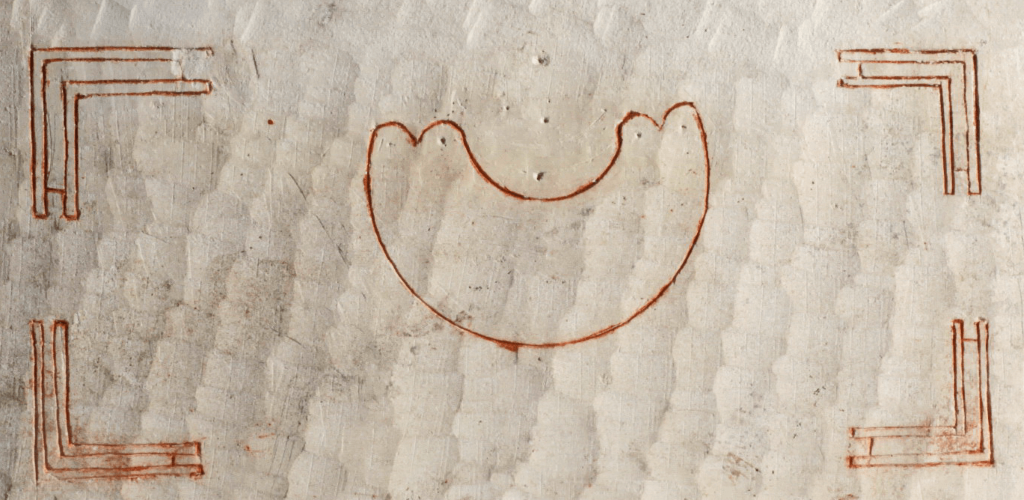
The floating form at the center of the structure appears to represent a spiritual, non-material element.
The stylistic and iconographic evidence clearly points to a symbolic depiction of a wing: “the Wing of the Shekhinah” (the divine presence), serving as a visual representation of divine protection.
Since Jewish art of the Second Temple period avoided anthropomorphic depictions of the Deity, it required a more abstract expression of divine presence, and the wing provided a perfect solution: a symbol of protection, inspiration, and closeness to the divine.
In both the art and theology of this period, the wing served as a spiritual metaphor for heavenly mediation and divine protection, and the image was associated with the celestial attendants of the divine realm, often portrayed as winged beings. In apocalyptic literature, such as 1 Enoch and Daniel, heavenly entities are described as winged, not necessarily “angels” in the later sense, but mediating forces between God and the world.
The roots of this image lie already in the Hebrew Bible, where God’s protection is described in the language of wings:
“May you be richly rewarded by the Lord, the God of Israel, under whose wings you have come to seek refuge” (Ruth 2:12); and “In the shadow of Your wings” (Psalms 17:8; 36:8; 57:2; 61:5; 91:4).
Most strikingly, the cherubim upon the Ark of the Covenant spread their wings upward and overshadow the cover (Exodus 25:20; 37:9) - a space understood in tradition as the dwelling place of the Shekhinah itself.
The image continued into early Christianity, where the divine spirit was represented as a dove, a winged creature symbolizing the Holy Spirit: “He saw the Spirit of God descending like a dove and coming upon him” (Matthew 3:16; cf. Mark 1:10; Luke 3:22; John 1:32).
Thus, the motif of the wing, or the winged bird, forms a clear symbolic continuum between Second Temple Judaism and early Christianity: both viewed it as a tangible representation of divine presence and protection.
The central placement of the form, hovering within the architectural frame, suggests a heavenly presence descending into the sacred space. This configuration may symbolize the Shekhinah extending her wings over the deceased, who was most likely a priest serving in the Temple. In this interpretation, the artist conveyed not merely a generic emblem of divine protection, but a personal expression of priestly sanctity under divine shelter.
Alternative interpretations of the form, such as a crown, jewel, lunula pendant, or purely decorative element, do not fit known Jewish iconography and find no parallels in Hellenistic-Roman art.
By contrast, the symbolic concept of the wing - as a sign of celestial presence, divine protection, and transcendent power - was well known and readily understood among the Jewish public of the Second Temple period, who lived in a Hellenistic-Roman cultural environment rich in winged imagery.
Although Jewish art generally avoided such depictions, the symbolic meaning of the wing was deeply rooted in the religious consciousness of the time - and here it finds a rare and independent artistic expression.
Accordingly, it seems evident that the artisan sought to bestow upon the deceased a unique mark of divine protection: the Wing of the Shekhinah spread above him in divine shelter.
This could also signify divine protection specifically directed toward the priestly class, implying that the deceased remained under the shadow of the Shekhinah in death just as he had served beneath it in life.
Visual and Iconographic Parallels
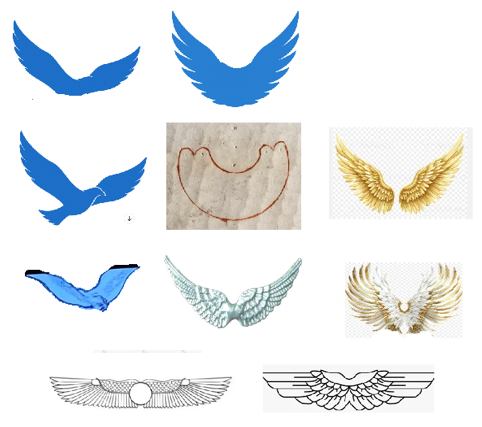
The floating form engraved on the ossuary, characterized by bilateral symmetry, a central depression, and two upward projections resembling feather tips, corresponds closely to the universal geometry of spread wings. This resemblance supports its interpretation as a stylized “Wing of the Shekhinah” rather than an abstract ornament. In keeping with the aniconic principles of Jewish art, the artisan avoided depicting the divine presence or its messengers directly, choosing instead a suggestive, associative form that alludes to divine shelter without portraying it physically.
The motif’s protective meaning finds clear analogues in the wider Hellenistic-Roman visual repertoire, where wings regularly served as emblems of divine guardianship. On Roman sarcophagi of the first and second centuries CE, for instance, paired winged Victories often hold the imago clipeata - the medallion bearing the likeness of the deceased - visually enclosing the soul within divine protection (e.g., Museo Capitolino, inv. MC2050; Walters Art Museum 54.57). Similarly, on Alexandrian and Roman–Egyptian funerary reliefs, the goddesses Isis and Nephthys extend their wings protectively over the mummy or sarcophagus lid, their inscriptions explicitly describing the wings as “spread in protection over the deceased.”
In the present case, there is no doubt that the deceased was Jewish, since the use of ossuaries was strictly confined to Jewish burial practice. Yet the artisan - and likely also the patron - was evidently influenced by the surrounding Hellenistic–Roman artistic world. In a remarkable synthesis, they adopted only the symbolic form of the motif, deliberately avoiding any realistic representation of a figure, creature, or physical wings. In doing so, they adhered scrupulously to the aniconic principles of Jewish law while expressing the same spiritual idea of divine shelter found throughout Mediterranean art.
A comparative illustration showing the proportional and morphological similarity between the ossuary wings' motive and symbolic wing motifs - both ancient and modern - is provided (see Photograph).
The Tradition of the ‘Wing’ Motif in Judah and the Hellenistic-Roman World
The motif of the divine wing on the ossuary of Zechariah belongs to a long and evolving symbolic tradition deeply rooted in the religious imagery of ancient Judah.
Already in the late eighth century BCE, royal and temple iconography in Jerusalem expressed divine protection and legitimation through winged symbols. Hundreds of LMLK (“belonging to the king”) jar handles from the reign of King Hezekiah (715–686 BCE), discovered in Jerusalem, Lachish, and in other Judean sites, bear impressions of a winged solar disk, a motif adapted from Egyptian and Assyrian art but reinterpreted locally as an emblem of divine authority and protection over the kingdom.
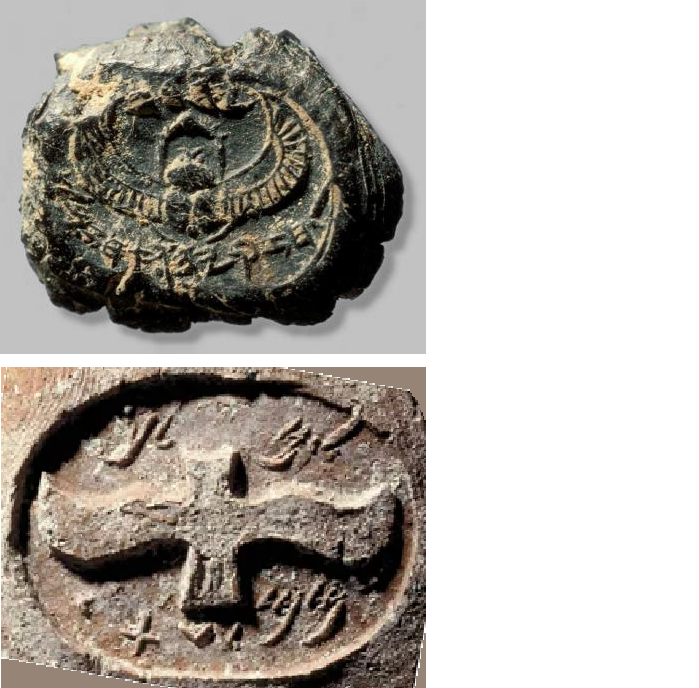
The same imagery appears on Hezekiah’s royal seal impressions (bullae) unearthed in Jerusalem and at Khirbet Kila (biblical Keilah). Alongside the inscription identifying the king, the seal shows a winged sun disk, sometimes flanked by an ankh, the Egyptian sign of life and immortality (see photos). The fusion of a Judahite royal inscription with winged and ankh symbols conveyed a powerful message: the king ruled under divine sanction and shelter.
Taken together, these artifacts demonstrate that the language of wings in Jerusalem iconography long symbolized divine protection, eternal life, and sanctified authority.
Its reappearance on the Zechariah ossuary, centuries later, reflects the persistence of that ancient symbolic vocabulary - transposed from the realm of kings and temples to the realm of personal faith and commemoration.
This continuity with royal and temple iconography strengthens the likelihood that the deceased held priestly status. The same symbolic lexicon that once conveyed Yahweh’s protection over kings and sanctuaries is here reinterpreted to mark divine favor toward an individual connected to the Temple. In this sense, the motif represents both continuity and transformation - from the protection of the kingdom to the salvation of the soul.
This Judean tradition found resonance in the broader Hellenistic–Roman visual culture of the first century CE, where wings universally signified divine presence, mission, or guardianship. In that environment, winged figures embodied victory (Nike), divine messengers (Hermes), or protective spirits, and appeared frequently on coins, monumental reliefs, and sarcophagi.
The wing carved on the Zechariah ossuary thus bridges multiple symbolic worlds: the ancient Judean concept of divine shelter, the Second Temple theological restraint against depicting the Deity, and the broader Mediterranean visual language in which wings denoted transcendence and divine protection.
It offers a rare synthesis. An image that both complies with Jewish aniconism and communicates, with elegant simplicity, the assurance of divine guardianship over the deceased.
Viewed this way, the motif may be read as a visual theology - the Shekhinah’s wing resting upon the priestly soul, extending the Temple’s holiness beyond life itself.
Two Tall Columns with Ionic Capitals
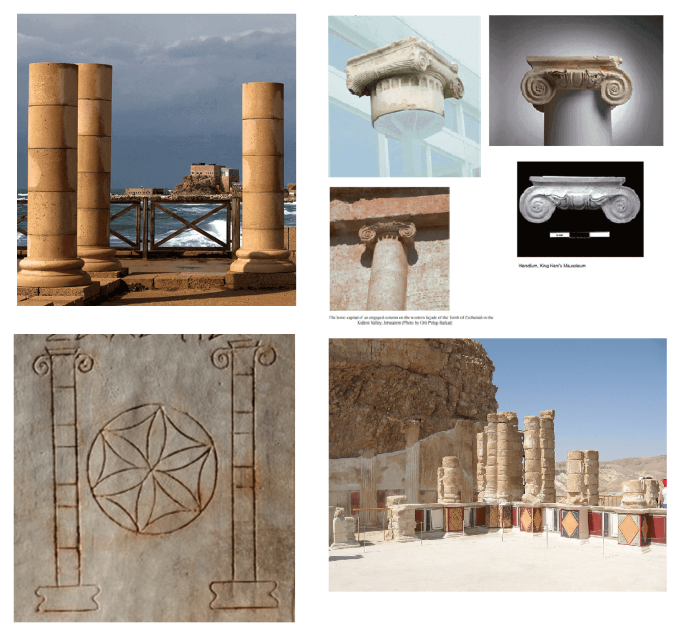
On the narrow side of the ossuary are depicted two tall columns, each composed of several drums, with bases and Ionic capitals. Their free-standing position recalls the biblical description of the two independent columns that stood at the entrance to the First Temple, named Jachin and Boaz - a tradition unique to the Jewish Temple in Jerusalem.
In Greek, Hellenistic, and later Roman architecture, temples were always defined by a row of columns - four, six, eight, or more - but never by a single pair of free-standing columns. In Hellenistic-Roman art, columns sometimes appear not as independent elements but as part of a wall, in the form of pilasters: decorative projections attached to the wall and supporting an entablature, yet not three-dimensional, weight-bearing columns. In contrast, the depiction of a pair of free-standing columns not attached to a wall reflects the biblical Jewish tradition rather than Hellenistic–Roman architectural conventions.
A notable feature of the ossuary’s decoration is that the columns are composed of multiple drums. Such segmented columns are characteristic of Herodian monumental architecture in Caesarea, Masada, and Herodium - major construction projects of King Herod, who also rebuilt the Temple in Jerusalem.
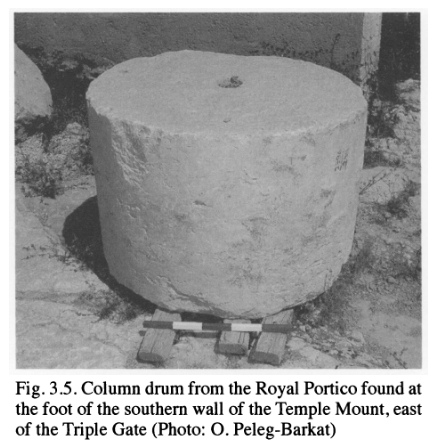
In archaeological excavations conducted south of the Temple Mount (Mazar, Reich), remains of several column drums were discovered, which had fallen - or had been deliberately toppled - from the architectural complex (stoa) built by King Herod as part of the Temple Mount compound, south of the Temple itself (see photograph of such a column from the Temple Mount excavations).
In other words, columns of this type indeed characterized the Temple complex. However, it appears that the two columns decorating the ossuary refer to two independent free-standing columns that likely stood in front of the Temple, or perhaps serve as a symbolic remembrance of the columns that stood at the façade of the First Temple, representing the Temple as a whole.
The depiction of columns composed of several drums is probably not accidental; it clearly indicates that these are not representations of columns hewn in the rock at the entrances to burial caves, such as those of the royal tombs at Petra.
Rosettes (Floral Motifs)
Between the two columns appears a six-petaled rosette, a common symbol on Jewish ossuaries. This motif is also known from the stone table of the first-century synagogue at Magdala (which also features six petals), as well as from a considerable number of architectural stone fragments discovered in the southern Temple Mount excavations (some of which bear rosettes with a higher number of petals).
Krater / Amphora – Motifs Associated with the Temple and Ritual Purity
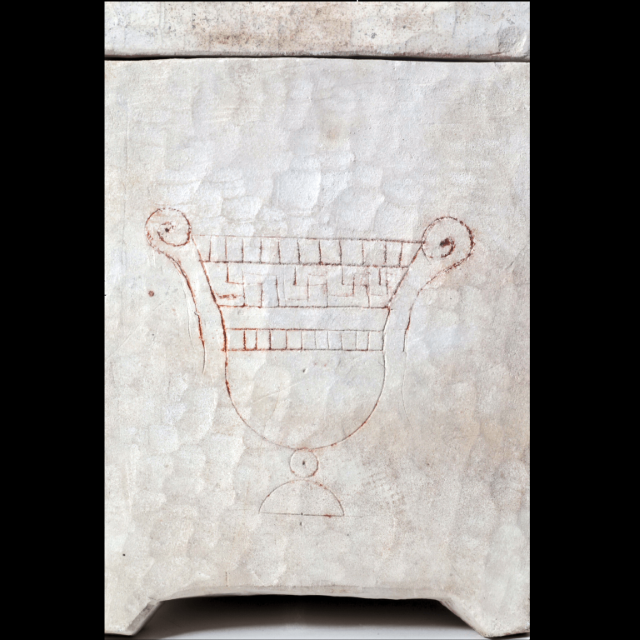
The vessel decorating the narrow rear panel of the ossuary is best identified as a krater, a large mixing bowl of Hellenistic-Roman design, distinguished by its wide mouth, outward-curving volute handles, and rounded body resting on a defined base.
This is, to the best of current knowledge, the only known representation of a krater from the early Roman period to appear on a Jewish ossuary, or on any other artifact from that era.
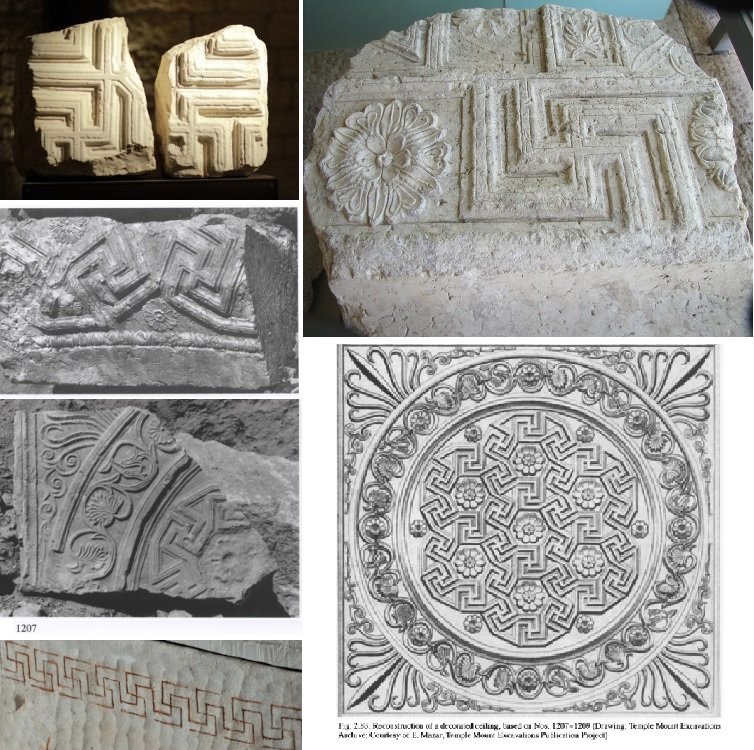
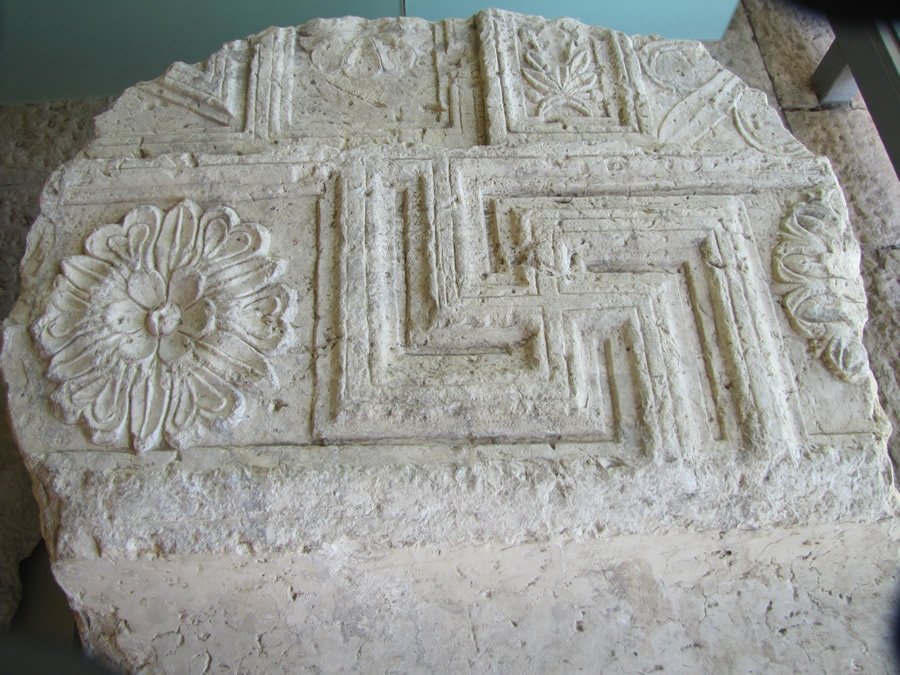
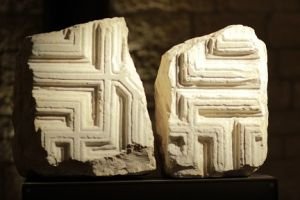
Across the upper part of the vessel runs a horizontal geometric meander ornament, a motif known from stone fragments unearthed in archaeological excavations south of the Temple Mount in Jerusalem. These fragments once formed part of the decorative architectural elements of the Second Temple complex.
The presence of the meander motif on this ossuary is therefore highly significant: it ties the imagery directly to the architectural and symbolic vocabulary of the Jerusalem Temple.
The krater itself likely symbolizes a ritual basin or libation vessel, such as the kiyor used for priestly purification, or the vessel employed in the water-libation ceremony during the Feast of Tabernacles (Sukkah 4:9). Its depiction may thus allude to the sacred implements of the Temple, emphasizing purity and divine service.
It is noteworthy that kraters originated in Greek culture of the 6th–5th centuries BCE, yet by the first century CE they were extremely rare in Judea. Those with volute (spiral) handles were usually made of clay, and more rarely of bronze or stone. When used in Jerusalem during this period, they most likely served in hand washing or ritual libation ceremonies within the Temple precincts.
According to Prof. Ehud Netzer, a single clay jug decorated with a meander pattern, discovered in the Jericho palace complex and dated to the first century CE, represents the only known example of such decoration on a vessel anywhere in the Roman Empire. This indicates not a Hellenistic or Roman influence upon the artisan, but rather a deliberate and conscious intention to apply a Temple-related motif derived from Jerusalem’s sacred architecture to a ritual vessel symbol.
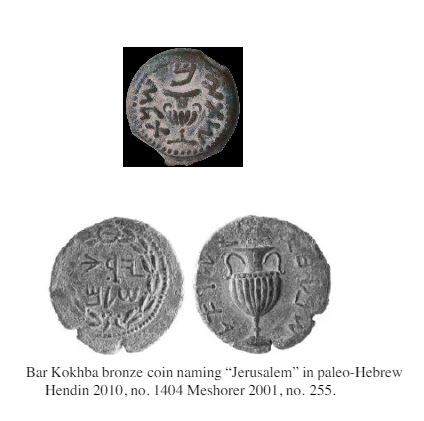
The presence of the krater on the ossuary recalls the appearance of amphorae - vessels with elongated necks and twin handles - on several Jewish ossuaries, as well as on Jewish coins dating from the Hasmonean period until the destruction of the Temple in 70 CE. The amphora most likely symbolized a container for pure oil used for lighting the Menorah, and thus became a symbol of purity, holiness, and Temple service.
It was among the few Jewish symbols that adorned ossuaries in the first century CE and served as a distinctive emblem in Jewish art of the period. The amphora also appears on Jewish vessels produced after the destruction of the Temple, particularly on so-called “southern” (Darom) oil lamps.
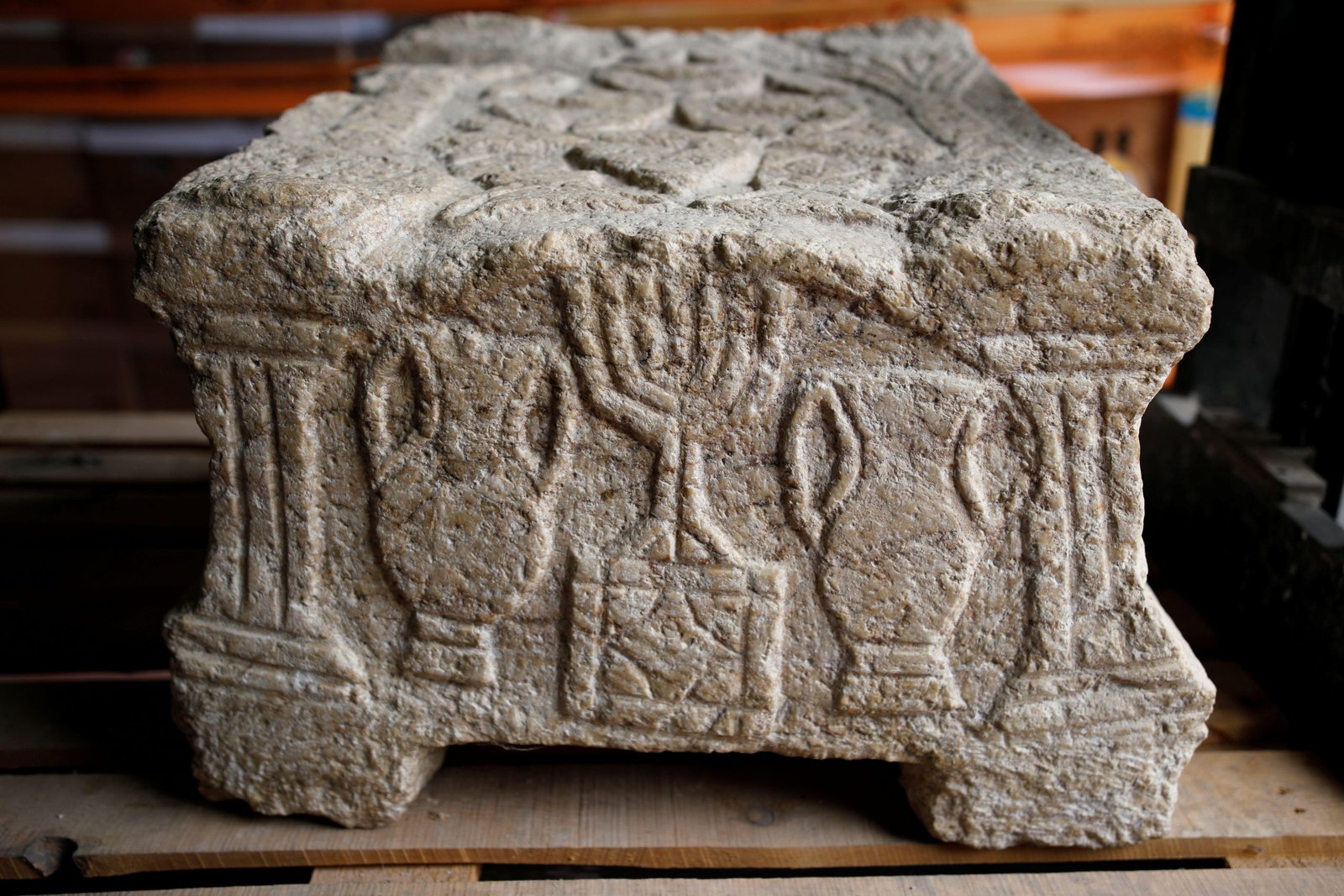
The symbolic importance of the amphora is further emphasized by the decorated stone table from the first-century synagogue at Magdala (Migdal), where a Menorah stands at the center flanked by two amphorae. This attests that the motif had already become part of the Jewish symbolic vocabulary in a religious context centered on the Temple, and that the amphora motif had established itself as a recognized Jewish emblem associated with purity, priesthood, and the sacred service of the Temple.
Geometric Meander – Architectural Motif of the Jerusalem Temple Complex
The other broad side of the ossuary displays a continuous geometric meander pattern, reminiscent of motifs known from Herodian Temple stones uncovered in the excavations of the Temple Mount (see photos). The geometric meander engraved on the back of the ossuary has no known parallels in any architectural element or fragment found in Israel, except for remains bearing this same decoration discovered on the Temple Mount itself, near the Temple complex. The meander thus constitutes a clear echo of a major geometric element that adorned the ceilings, and possibly also the walls, of the structures surrounding the Temple, and perhaps even the Temple itself.
The meander motif originated in Greece and was later adopted in the architecture of monumental Roman temples - for example, in the Temple of Jupiter at Baalbek from the late first century BCE, and in the Ara Pacis (Altar of Peace), dedicated in 13 BCE to celebrate Emperor Augustus’s return from his campaigns in Gaul and Spain.
Two Crescents (Moons) - A Symbol of Renewal and Resurrection in Second Temple Judaism
A unique motif on this ossuary is the decoration of two crescent moons on its broad back panel. The moon held a central symbolic role in the religious worldview of Second Temple Judaism, and particularly within priestly thought. As Ben Sira states: “The moon determines the times of the holy days, a luminary that marks the fixed seasons; its renewal bears its name” (Sirach 43:6–8) - a clear indication that the moon served as the measure for the festivals and sacred times entrusted to the priests.
The Book of Enoch (1 Enoch 72–82, “The Book of the Luminaries”) also describes in detail the course of the moon and the order of its cycles: “It waxes for fourteen parts until it becomes full, and then wanes for fourteen other parts until it disappears.” This passage reflects a theological understanding in which the lunar cycle - its renewal, fullness, and disappearance - symbolizes the divine rhythm of time, established to preserve the sanctity of creation and the cosmic priestly order.
In the Qumran Scrolls, in the prayer known as Words of the Luminaries (4Q504–506), thanksgiving is offered for “the lights You have set for appointed times and festivals” a clear expression of the belief that control over the lunar and temporal cycles belongs to the priestly order and its sacred service.
Jewish thought of the period shows a deep identification with the moon’s cycle: just as the moon wanes and disappears yet returns and is renewed, so too the soul is not extinguished but destined to rise again. This idea later found ritual expression in the Blessing of the Moon (Kiddush Levanah), recited monthly by every Jew, usually in public and under the open sky, upon the appearance of the new moon. The blessing expresses faith in the cyclical nature of time, in spiritual renewal, and in the belief that the people of Israel will themselves be renewed and restored to their light.
Whereas in Nabataean and Syrian-Phoenician cults the moon was regarded as a celestial deity, in Jewish belief it served as a cyclical symbol of creation, renewal, and redemption - not as a divine being. The two crescent shapes together may emphasize the transition from darkness to light, from this world to the world to come, or the relationship between impurity and purity - dualities that echo the priestly worldview and its concern with boundaries of sacred time and order.
Against this background, the appearance of two lunar symbols on a Jewish ossuary is no coincidence. The presence of two moons (rather than one) suggests that the decoration does not depict a pagan sky-god but rather reflects the Jewish concept of renewal and resurrection that took root in this era.
If the deceased was indeed a priest, as can be inferred from additional evidence, the lunar motif gains even deeper meaning: the priests were responsible for sanctifying the new month and regulating the calendar, which was organized according to lunar cycles (see Josephus, Antiquities of the Jews III 237–243; Philo, De Specialibus Legibus II 41–43). They were seen as guardians of the divine cosmic order - those who preserved the rhythm between time, purity, and light. Thus, the symbol of the moon on a priest’s ossuary may allude both to his ritual office and to his faith in the renewal of the soul and the resurrection to come.
Synthesis of the Motifs
Each motif on its own may appear “general” or open to multiple interpretations. Yet their true meaning emerges only when they are viewed together, within the iconographic program they collectively form.
The semi-circular form (“the wing”) floating within a monumental structure featuring openings has no known parallels in Greek, Hellenistic, or Roman art. The two tall columns standing in front of the building, unattached to it, represent a completely foreign type in Greco-Roman architecture, where temples were characterized by colonnades attached to walls. The meander pattern carved on the ossuary is known as a hallmark of the Temple and its surrounding complex built by King Herod, and not of any other structures in the Land of Israel. The amphora represents a ritual vessel associated in Judaism with Temple worship, and the moon symbol may suggest that the deceased was a priest responsible for sanctifying the new month, determined by the lunar cycle.
The likelihood that this rich and specific assemblage of motifs was created by coincidence is exceedingly small. The combined composition almost inevitably leads to the conclusion that the decorations were intended to commemorate the Temple in Jerusalem, to signify the deceased’s connection to it - as a priest, and to invoke the protective presence of the “Wing of the Shekhinah.”
The Name Ζαχαρίας (Zacharias) in Greek
The ossuary bears a carefully inscribed Greek name: Ζαχαρίας (Zacharias). It was engraved by a professional artisan, most likely in the workshop where the ossuary itself was made, rather than hastily scratched in a burial cave as was the case with most inscriptions. Only about 2% of inscribed ossuaries were engraved in advance, outside the burial cave, and with such deliberation.
The inscription includes only the deceased’s personal name - Zacharias - without a patronym, implying that the individual was well-known and respected in his community, so that the mention of his given name alone sufficed for identification.
Among roughly 650 published inscribed ossuaries, the name Zechariah (in Hebrew or Greek) appears on only four: twice in Hebrew and twice in Greek (ΖΑΧΑΡΙΟΥ), indicating its rarity - statistically fewer than one in two hundred men (Tal Ilan, Lexicon of Jewish Names, Cotton 2010, Rahmani 1994).
The precise spelling Ζαχαρίας (Zacharias) appears only once in the entire ossuary corpus—on this ossuary—and it exactly matches the form of the name of Zechariah the priest in the New Testament Gospels.
Greek was widely used in Jerusalem’s commerce and culture, and about 30% of ossuary inscriptions are written in Greek. Priests with Greek names are well attested (e.g., Jason, Menelaus, Alcimus, and Theophilus), as are members of the Hasmonean and Herodian dynasties.
Attribution of the Ossuary to a Priest
The decorative program presents a coherent ensemble of symbols, several of which are directly related to the Temple service of the priests. These include the two free-standing columns (symbolizing the entrance to the Temple), the meander pattern, associated with the geometric designs that adorned the ceilings and walls of the Temple complex, and the amphora, used for libations and filling the menorah with oil.
Additional motifs are linked to divine presence and protection (“the Wing of the Shekhinah” hovering within a schematic monumental structure) and to Jewish identity and hope for resurrection and redemption (the two crescent shapes).
This consistent and purposeful symbolism strongly suggests that the deceased was a Temple priest of high standing and reputation.
Identification of Zacharias as Zechariah the Priest, Father of John the Baptist
Demographic estimates suggest that Jerusalem’s population in the first century CE ranged between 40,000 and 60,000. According to Josephus, about 20,000 priests lived throughout Judea, though scholars believe the actual number was considerably smaller; only about 1,000–1,500 resided permanently in Jerusalem. During the roughly ninety years of ossuary use, the number of priests named Zechariah (in Hebrew or Greek) would have been very small - perhaps only a handful, making it statistically exceptional compared with common priestly names such as Eleazar, Joseph, or Mattathias.
The spelling Ζαχαρίας, as on this ossuary, is known from only one ancient source, the New Testament, where it refers to Zechariah the priest, father of John the Baptist, who announced the coming of the Messiah (Jesus, according to Christian belief).
Zechariah the priest is mentioned in three of the Gospels. He served in the Temple, where he encountered the angel Gabriel, who told him that his wife Elizabeth would bear a son who would prepare the way for the Messiah. His son, John the Baptist, became the herald of the Messiah and, according to the New Testament, the one who baptized Jesus himself.
The New Testament notes that the divine revelation to Zechariah “was heard throughout all the hill country of Judea” (Luke 1:65), a remarkable detail that strengthens the identification of this Zacharias with Zechariah the priest and explains the desire to commemorate the one figure said to have met the angelic messenger of God.
When considering the combined independent evidence, the unique iconography related to the Temple, the rare name, and the singular Greek spelling - the probability of any identification other than Zechariah the priest, father of John the Baptist, becomes exceedingly low.
The Lost Ossuary of Zechariah the Priest – Evidence and Interpretation
This distinction becomes even clearer when compared with another famous ossuary - the one publicized as “The Ossuary of Caiaphas the High Priest.”
On that ossuary appears the inscription “Yohasef bar Qopha (or Qopa),” a name linguistically different from the historical form Caiaphas and from the full name of the high priest as recorded by Josephus: “Yoseph who was called Caiaphas” (Antiquities of the Jews).
Moreover, in the burial cave where that ossuary was found, no evidence was discovered of any family or functional connection to the priesthood. In fact, a coin was found in the mouth of one of the deceased - a pagan custom, not a priestly one.
If the so-called “Caiaphas” (in fact “Qopha”) ossuary represents a dubious attribution despite its fame, then in the case of the ossuary inscribed Ζαχαρίας (Zacharias) the situation is entirely the opposite. Here, the Greek spelling of the name matches exactly that of Zechariah the priest, the father of John the Baptist; the inscription was carved by a professional artisan; and the unique iconographic program surrounding it - the two free-standing Temple columns, the ceremonial amphora, the geometric “meander” pattern known from the Temple precinct, and the “Wing of the Shekhinah” (Divine Presence) spreading protectively - all clearly indicate a priestly status and a direct association with Temple service.
As with Leonardo da Vinci’s Salvator Mundi, whose attribution was debated yet ultimately accepted because of the convergence of stylistic, historical, and technical evidence - the cumulative alignment of name, artistry, and symbolism here reaches a probability that commands serious scholarly attention.
While absolute certainty is unattainable, the evidence makes it historically and culturally plausible - indeed, likely - that this is the ossuary of Zechariah the priest, father of John the Baptist.
Between Zechariah the Prophet, Herald of the Messiah’s Coming - and Zechariah the Priest, Father of John the Baptist, Who Announced the Coming of Jesus
There is no doubt that the deceased named on the ossuary, Ζαχαρίας (Zechariah), was named after the prophet Zechariah son of Berechiah, who lived in the sixth century BCE during the Return to Zion and the rebuilding of the Second Temple.
The prophet Zechariah was among the most influential figures in shaping the concept of messianism, particularly in forming the early Christian understanding of the Messiah.
A priestly family such as that of Zechariah the priest would not have chosen this name by chance: he was named after the prophet associated with the vision of the Temple, the Divine Presence (Shekhinah), and the promise of redemption.
In early Christian tradition, Zechariah son of Berechiah was regarded as the first great herald of the Messiah:
- He foresaw Jesus’ entry into Jerusalem riding on a donkey (Zechariah 9:9).
- He wrote of “the one they have pierced” (12:10) - a verse identified with the crucifixion.
- He mentioned “the thirty pieces of silver” (11:12–13) - associated with Judas’s betrayal.
It is possible that the decorations on the ossuary allude not only to the priestly role of the deceased Zacharias and the divine favor shown to him, but also, perhaps intentionally, to a spiritual connection with the prophet Zechariah after whom he was named.
The artisan may thus have sought to express, through the decorative motifs, both the priestly status of Zechariah the priest whose bones were placed within and the continuity of prophecy and divine spirit uniting the Temple, redemption, and the new faith that emerged from them.
Between the Temple and the Dawn of Faith
Just as the Dead Sea Scrolls opened a window into the spiritual, legal, and mystical world of Judaism on the eve of Christianity’s birth, so too the ossuary of Zechariah reveals a rare glimpse into that same transitional age - the priestly world from which the early messianic movement emerged.
Its value, therefore, lies not only in the possible identification with Zechariah the priest, father of John the Baptist, but in the way it embodies the beliefs, symbols, and hopes of a society standing at the threshold between Temple Judaism and the new faith that would soon arise.
Regardless of ultimate identification, it is a unique window into the religious art, symbolism, and theology of Jerusalem in the final generation of the Second Temple – an age that gave birth to the ideas later shaping early Christianity.
In this sense, its historical significance may be seen as parallel - though in different form - to that of the Dead Sea Scrolls.
Conclusion
It is no coincidence that the New Testament records how the vision of the angel Gabriel to Zechariah the priest, announcing the birth of his son John, “was heard throughout all the hill country of Judea” (Luke 1:65).
John became a charismatic figure, regarded as both prophet and herald of Jesus. The Ossuary of Zechariah thus offers a rare material testimony to a key figure and a foundational story at the dawn of Christianity - a remnant unparalleled in the archaeological record.
Viewed in its broader historical and cultural context, the ossuary of Zechariah stands among the most remarkable artifacts linking the priestly world of Jerusalem’s Second Temple with the earliest messianic movements that emerged from it.
Even apart from questions of identification, its iconography and craftsmanship illuminate the shared religious imagination of late Second Temple Judaism - a world in which ideas of divine presence, redemption, and renewal were already taking shape.
When all the independent indicators are considered together :the unique Greek inscription, the Temple-related iconography, the deliberate artistic execution, and the demographic probability - the identification of this ossuary attains a level of confidence that, by any reasonable scholarly standard reaches a level of probability rarely achieved in artifact attribution.
While absolute identification in archaeology is seldom possible, the convergence of linguistic, artistic, and contextual data leaves one compelling conclusion: the Ossuary of Ζαχαρίας (Zacharias) is best understood as that of Zechariah the priest, father of John the Baptist - a finding of exceptional historical and spiritual significance.
It thus represents not merely an archaeological discovery, but a tangible link between the ritual world of the Temple and the emerging faith in redemption that would soon transform the spiritual landscape of the region.
References:
Photo 1: The ossuary of Zacharias (Ζαχαρίας – Zacharias) – View of the wide façade (a building with a hovering form, most likely representing the “Wing of the Shekhinah” - "Wing of God") and the narrow façade (the name Zacharias in Greek, two tall columns, and a six-petaled rosette).
Photo 2: The ossuary of Zacharias (Ζαχαρίας – Zacharias) – View of the narrow façade: the name Zacharias in Greek, two tall columns, and a six-petaled rosette.
Photo 3: The ossuary of Zacharias (Ζαχαρίας – Zacharias) – View of the back façade: a meander motif typical of the Temple Mount complex (Second Temple, Jerusalem), and two crescents symbolizing renewal and resurrection in Judaism.
Photo 4: The ossuary of Zacharias (Ζαχαρίας – Zacharias) – View of the narrow rear façade: a large amphora.
Photo 5:
- Top left: Column drums from Herod’s palace by the Sea of Caesarea.
- Top right: Ionic capitals discovered in excavations of Jerusalem’s Upper City.
- Bottom left: Column drums on the ossuary of Zacharias.
- Bottom right: Column drums from Herod’s Northern Palace at Masada.
Photo 6: Two ossuaries decorated with schematic depictions of a building: rectangular frames, with central doors and columns.
Photo 7: Decoration of the hovering form within a building that is open on all sides, symbolizing free entry and exit to the “Wing of the Shekhinah ("Wing of God").”
Photos 8-9: Meander patterns carved on stones from the Temple complex in Jerusalem, discovered in excavations at the foot of the Temple Mount.
Photo 10: Meander motif similar to that on the ossuary of Zacharias from Jerusalem (Franciscan Church Collection, Jerusalem).
Photo 11: Stone table from the ancient synagogue at Magdala (on the Sea of Galilee), dating to the first century CE – probably used to place a scroll for public reading. The table shows two tall columns, two amphorae, and the Temple menorah with a square base.
Photo 12: Coins from the time of the First Jewish Revolt against Rome (c. 70 CE) and from the Bar Kokhba Revolt (132 CE), bearing amphora motifs.
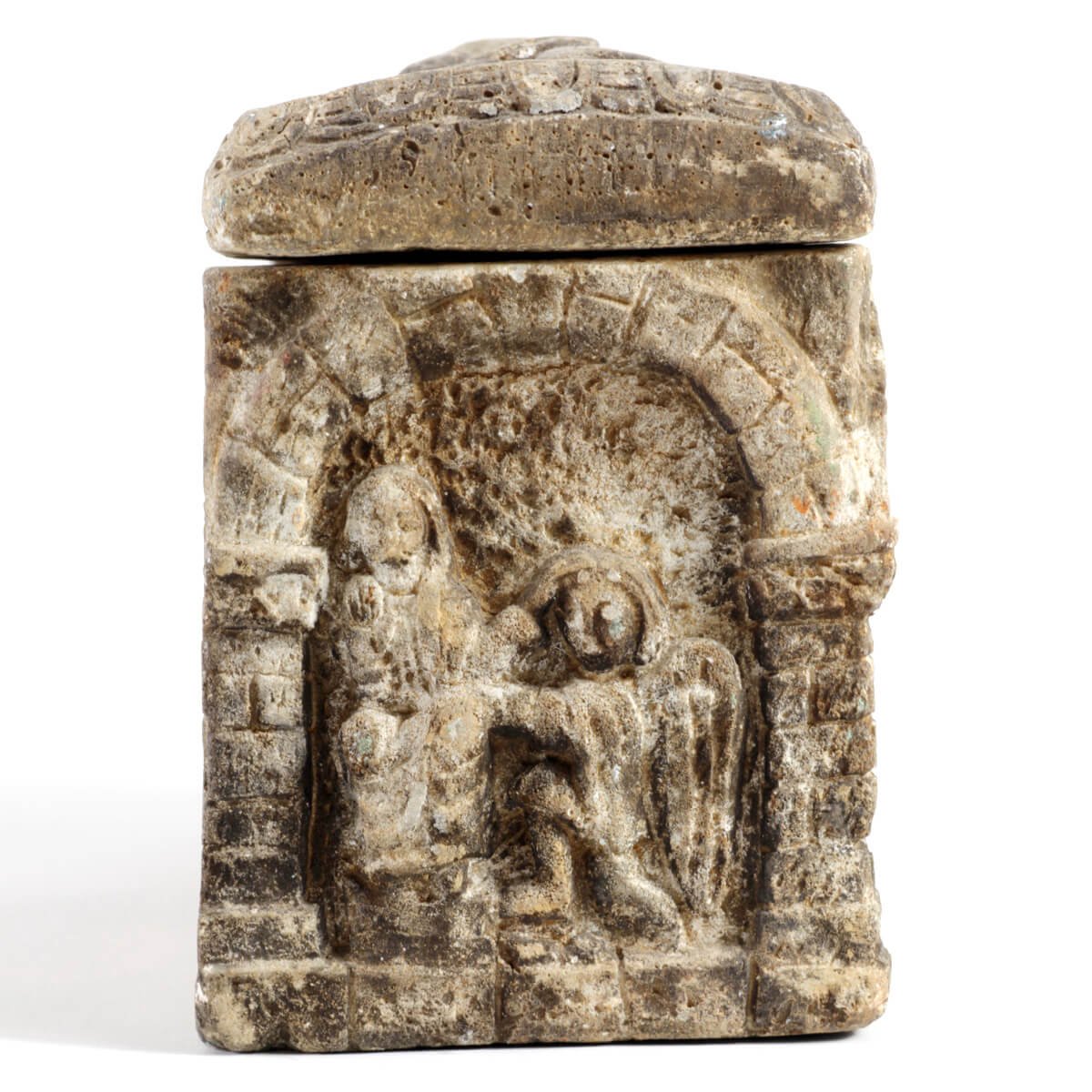
Photo 13: Reliquary (stone container for a holy object or relic of a Christian saint), carved with the story of the angel Gabriel’s encounter with Zechariah the priest, father of John the Baptist. Third century CE (Golan Collection).
Photo 14:
Left: Seal impression (bulla) of King Hezekiah from the royal archive at Khirbet Keilah (Keilah), bearing the inscription: “Belonging to Hezekiah (son of) Ahaz, King of Judah.”
Right: Royal seal impression of King Hezekiah’s administration on a jar handle.
The wings symbolized the Kingdom of Judah during the period of King Hezekiah’s religious reform.
In ancient Near Eastern iconography, outstretched wings signified the protective presence of a deity or the king’s role as God’s appointed guardian of his people. In Hezekiah’s seals, this motif thus embodies both theological and political meaning: divine endorsement and the protective sovereignty of Judah’s reformed monarchy.