“The Temple” Ossuary
Site item id
20265
Collection name
Item period
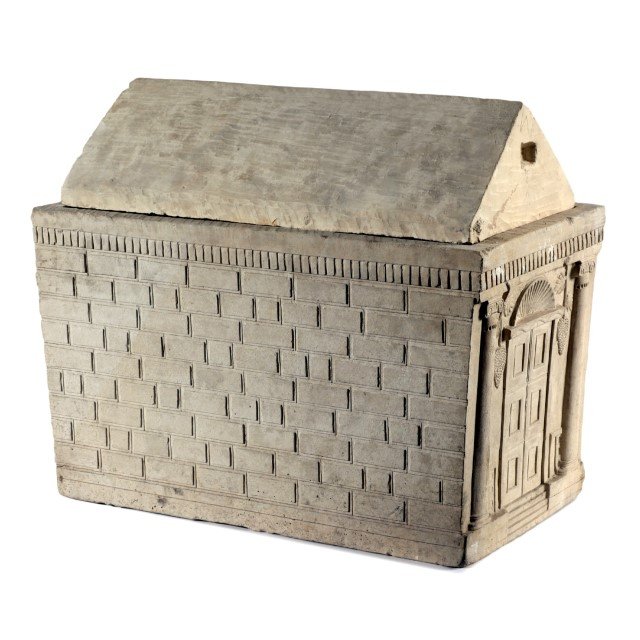
An elaborate ossuary, designed in the shape of a magnificent building with drafted ashlar walls and gates.
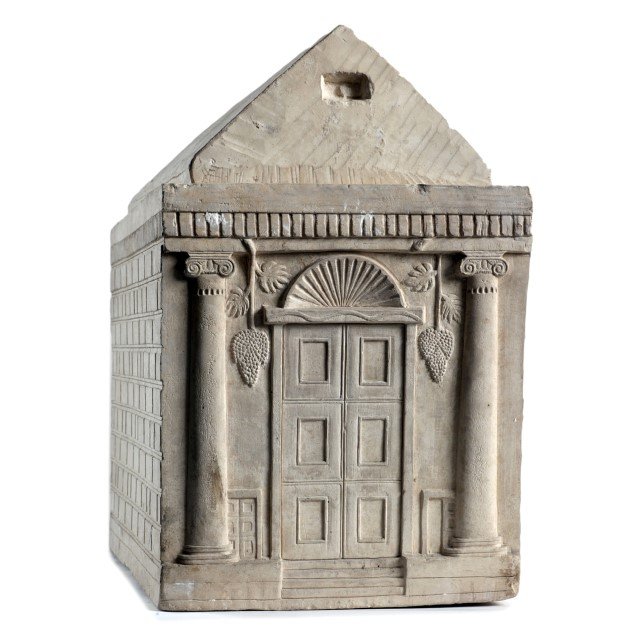
On one narrow side of the ossuary, a staircase is depicted leading up to a tall front gate with two massive closed doors, above which rests a pediment (arch) supported by the lintel. On either side of the gate stand two tall columns with Ionic capitals. From the lintel hangs a cluster of grapes, serving as a decorative element.
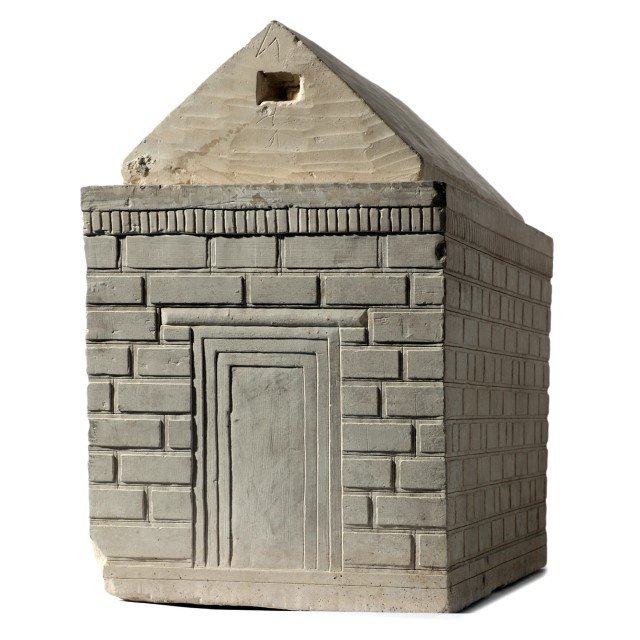
The rear gate (on the other narrow side of the ossuary) is rectangular, formed of several “receding” frames, and has no staircase. On one of the long sides appears a wall built of carefully dressed Herodian-style ashlars. The other long side is plain. It is possible that the building was intended to represent the Temple built by King Herod in Jerusalem.
More than sixteen ossuaries are known that bear decorations of “ashlar masonry,” usually represented schematically. In these ossuaries no doors or openings appear. This is the only known ossuary that depicts an entire building constructed of drafted stones, in great detail. Another ossuary, discovered on Mount Scopus, depicts a building with two entrances (on the narrow sides of the ossuary) and tall windows (on the long sides). It was identified by L. Y. Rahmani as depicting the façade of a grand tomb, similar to the façade of one of the monumental rock-cut tombs in Petra, rather than a building (no. 482 in Rahmani’s Catalogue of Jewish Ossuaries, Israel Antiquities Authority Collection; see also on this site).
The drafted stonework on the ossuary clearly connects it to the Jerusalem Temple Mount complex. The façades of the structure do not imitate tomb façades, nor do they bear Nabataean or Hellenistic motifs. It is therefore reasonable to assume that the artist’s intention was to represent the Temple itself, which was still standing when the ossuary was made - or at the very least to incorporate identifiable elements from it.